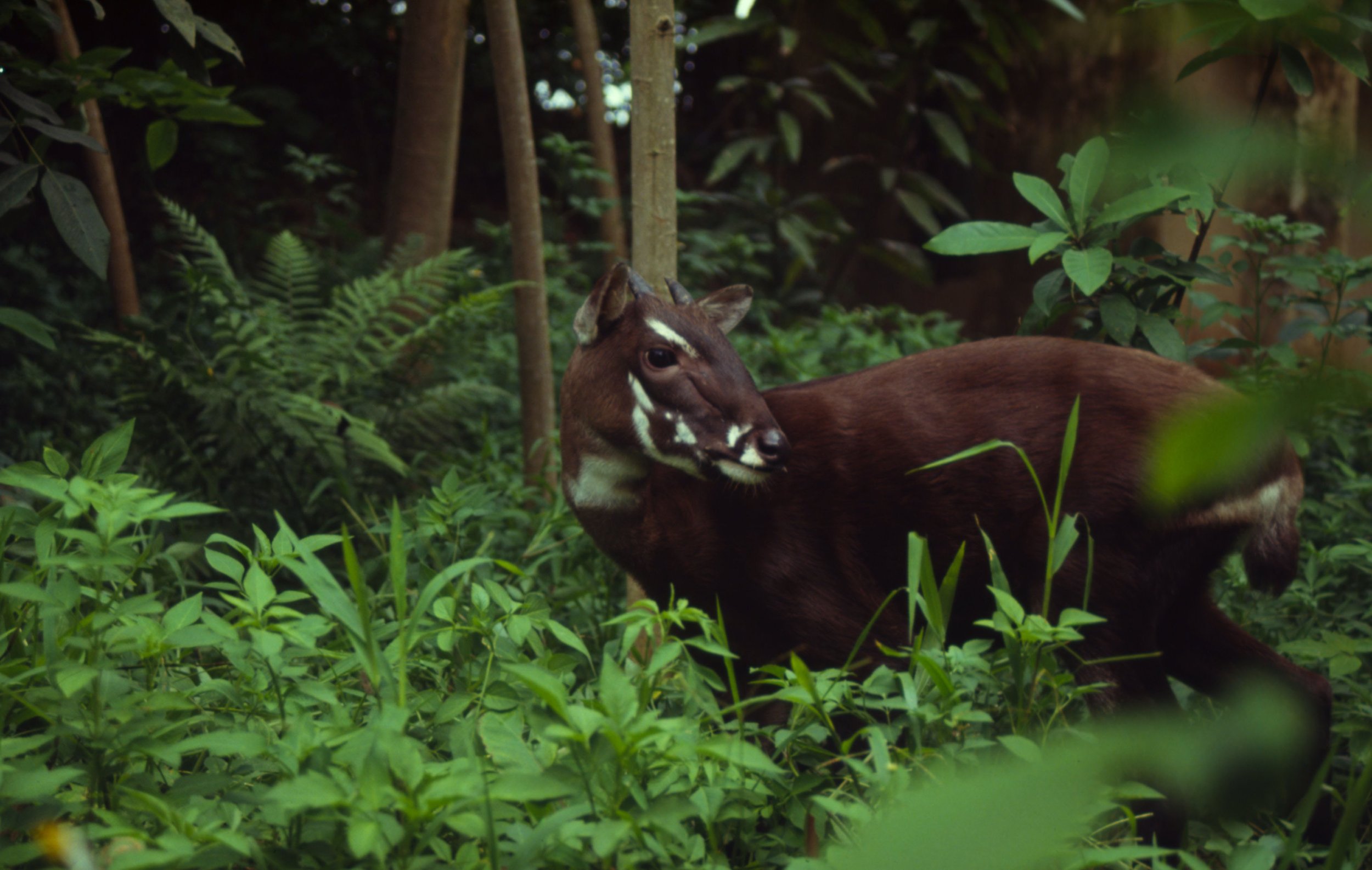
Pseudoryx nghetinhensis
Meet the Saola
Deep within the forests along the border of Laos and Vietnam lives an animal so mysterious that it has earned the nickname “Asian unicorn.”
The saola isn't mythical—but seeing one is extraordinarily rare.
Scientists only discovered the species in 1992 after unusual horns were found during a biological survey. The discovery of an entirely unknown large mammal stunned the scientific world.
With a dark brown coat, striking white facial markings, and two long, nearly parallel horns, the saola resembles an antelope. However, it is actually a member of the cattle family.
Quick Facts
Scientific Name: Pseudoryx nghetinhensis
Range: Laos and Vietnam
Habitat: Moist forests of the Annamite Mountains
Diet: Primarily vegetation
Conservation Status: Critically Endangered
What Makes Them Special?
Almost everything about the saola is mysterious.
Scientists have never conducted a detailed study of a healthy saola population in the wild, and very few people have ever seen one alive.
Its discovery also demonstrated something incredible: even in the modern world, large animals can remain scientifically unknown in remote habitats.
Their Role in the Ecosystem
Because saolas are so difficult to study, scientists still have much to learn about their ecological role.
As herbivores, however, they likely interact with forest vegetation and contribute to the complex relationships between plants and animals within their ecosystem.
Protecting saola habitat also protects countless other species living in the Annamite forests.
What Threatens Them?
One of the greatest threats to the saola is snaring.
Wire snares placed throughout forests to capture wildlife don't discriminate between species. Even when hunters aren't specifically targeting saolas, the animals can become trapped.
Habitat loss and fragmentation add additional pressure to an already extremely small population.
Conservation in Action
Conservation organizations are working with communities and governments in Laos and Vietnam to remove snares, protect habitat, improve wildlife monitoring, and prevent illegal hunting.
Scientists are also searching for evidence of surviving saolas using technologies such as camera traps and environmental DNA.
How You Can Help
Support organizations working against illegal wildlife trafficking and indiscriminate snaring.
You can also help by talking about species like the saola. Animals that almost nobody knows exist can easily disappear without much of the world noticing.
Did You Know?
The saola was only scientifically discovered in 1992.
Both males and females have long horns.
Despite its nickname, it isn't closely related to a unicorn—or even a horse.
Scientists still don't know exactly how many remain.
Photographs of living wild saolas are exceptionally rare.