OCTOBER - Purple Frog
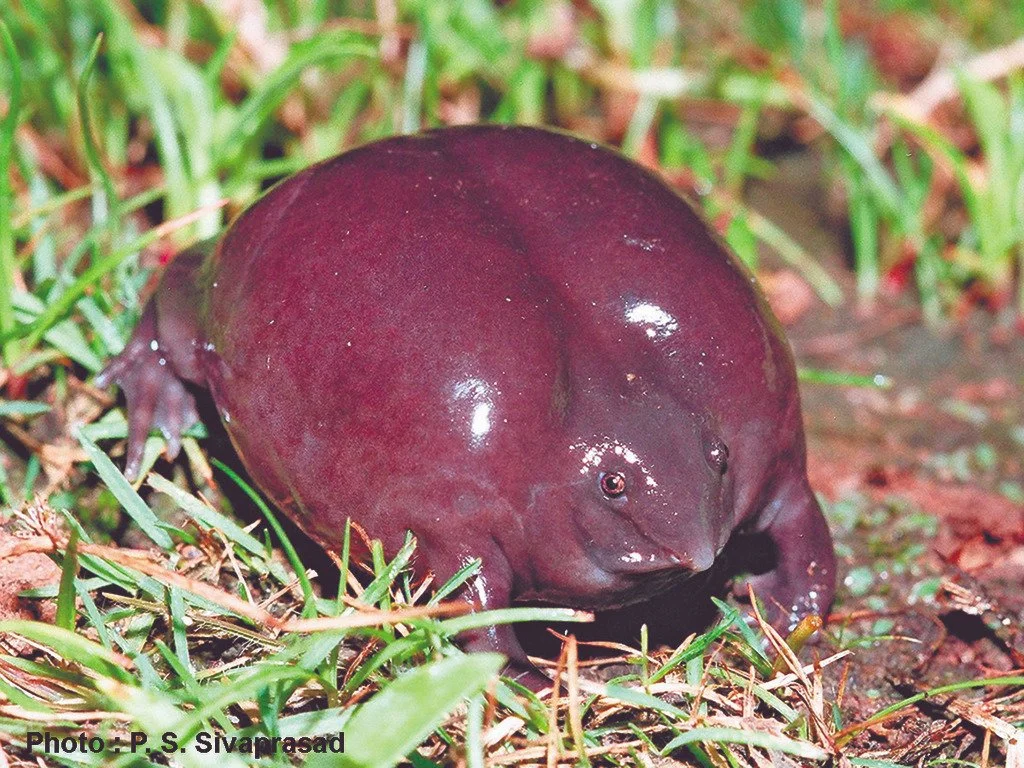
Nasikabatrachus sahyadrensis
Meet the Purple Frog
For most of the year, one of India's strangest frogs is almost completely invisible.
That's because it's underground.
The purple frog has a round, bloated-looking body, tiny eyes, powerful limbs, and a pointed snout that gives it an appearance unlike almost any familiar frog. Although local communities were familiar with it, the species wasn't formally described by scientists until 2003.
It spends most of its life beneath the soil and emerges primarily during the monsoon season to reproduce.
Quick Facts
Scientific Name: Nasikabatrachus sahyadrensis
Range: Western Ghats of India
Habitat: Moist forest soils
Diet: Primarily termites and other small invertebrates
Conservation Status: Threatened
What Makes Them Special?
Purple frogs are built for digging.
Rather than hopping around ponds like many frogs, their strong limbs allow them to burrow through soil, where they spend much of their lives searching for food.
Their evolutionary history is also remarkable. Their lineage is ancient, making them an especially unusual branch of the amphibian family tree.
Their Role in the Ecosystem
By feeding on underground insects such as termites, purple frogs participate in the hidden ecosystem beneath the forest floor.
Their dependence on both healthy soil and seasonal waterways also makes them an example of how amphibians can connect different parts of an ecosystem.
What Threatens Them?
Habitat loss and changes to waterways threaten the forests and breeding areas purple frogs rely upon.
Because they have a restricted geographic range, environmental changes within that relatively small area can have an outsized impact on the species.
Conservation in Action
Protecting the biodiversity-rich Western Ghats is essential for the purple frog and thousands of other species.
Scientists continue studying its population, breeding behavior, habitat requirements, and evolutionary history.
How You Can Help
Support amphibian and rainforest conservation and learn about the importance of protecting smaller animals—not just large, charismatic wildlife.
Frogs are also particularly vulnerable to environmental changes, making healthy amphibian populations important indicators of ecosystem health.
Did You Know?
Purple frogs spend most of their lives underground.
They emerge during seasonal rains to breed.
Their pointed snouts help them feed underground.
Their tadpoles are adapted to fast-flowing streams.
The species was formally described by scientists only in the 21st century.