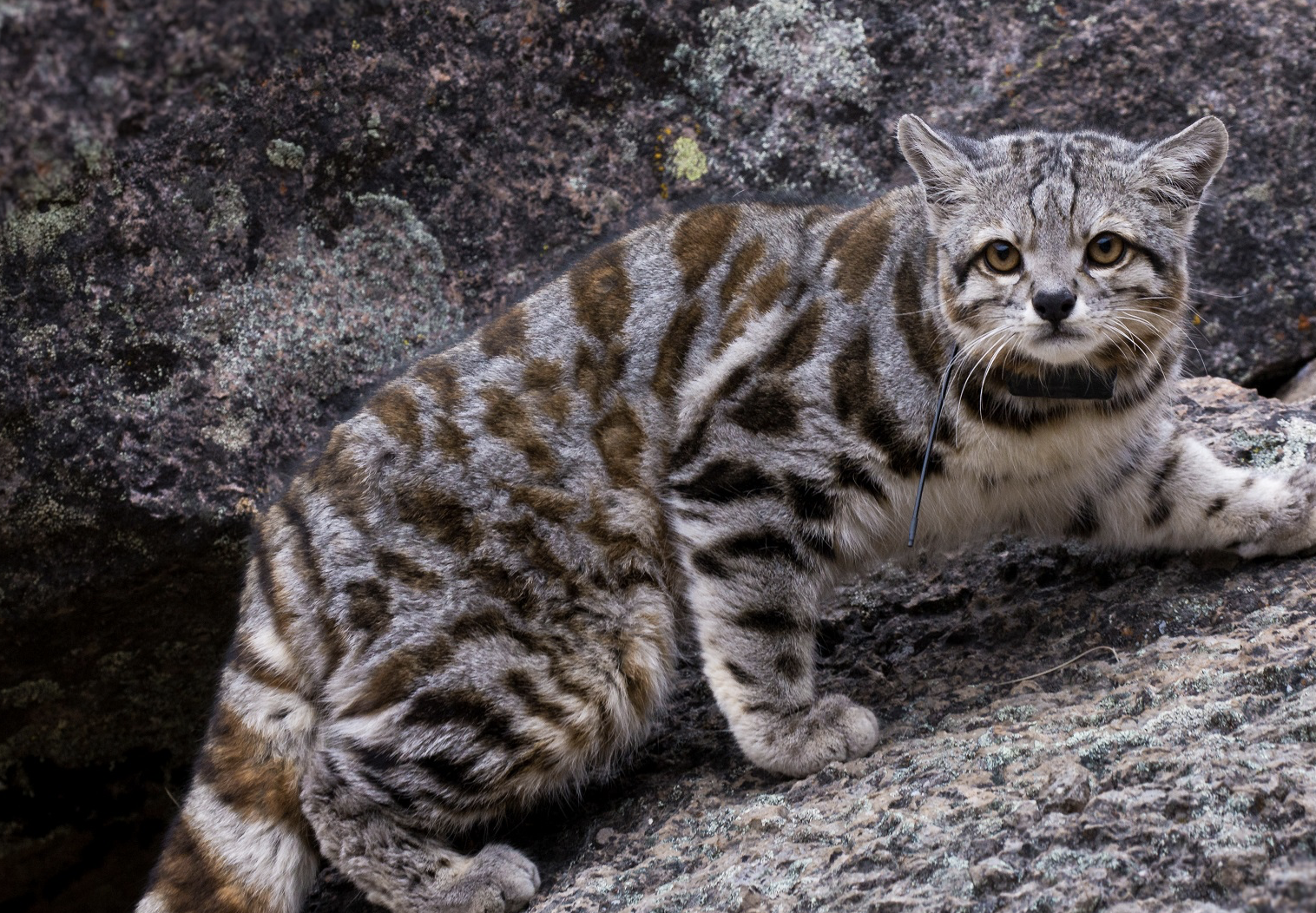
Leopardus jacobita
Meet the Andean Mountain Cat
High among the rocky slopes of the Andes lives one of the world's most mysterious wild cats. The Andean mountain cat is so elusive that for years, scientists knew very little about how it lived in the wild.
About the size of a large house cat, it has thick grayish fur, dark markings, and an exceptionally long, fluffy, ringed tail. Its dense coat helps it survive the freezing temperatures and harsh winds of its mountainous home.
Quick Facts
Scientific Name: Leopardus jacobita
Range: Argentina, Bolivia, Chile, and Peru
Habitat: Rocky, high-elevation regions of the Andes and Patagonian steppe
Diet: Small mammals, particularly mountain viscachas, as well as other small prey
Conservation Status: Endangered
What Makes Them Special?
One of the Andean mountain cat's most recognizable features is its enormous tail, which can measure around two-thirds the length of its body. Scientists believe the tail may help the cat balance while navigating steep, rocky terrain.
They're also remarkably difficult to observe. Camera traps, genetic samples, and other noninvasive techniques have become especially important for studying a species that researchers rarely encounter face-to-face.
Their Role in the Ecosystem
As predators of small mammals, Andean mountain cats are part of the delicate food webs of high-altitude ecosystems. Protecting them also means protecting the mountain habitats and prey species they depend upon.
What Threatens Them?
Their small, fragmented populations face several threats, including habitat degradation, reductions in prey, interactions with domestic animals, and killing by humans.
Mining and expanding infrastructure can also alter the remote landscapes these cats depend upon.
Conservation in Action
Researchers across South America are using camera traps, genetic research, community education, and habitat protection to better understand and conserve the species.
Because the cats cross national borders, their survival also requires cooperation between multiple countries and local communities.
How You Can Help
Support organizations that protect wild cats and Andean ecosystems, learn about where materials used in everyday products are sourced, and share information about lesser-known endangered species.
Simply helping more people discover animals like the Andean mountain cat can make their conservation harder to overlook.
Did You Know?
The Andean mountain cat wasn't photographed in the wild until relatively recently.
Its thick coat is an adaptation to an extremely cold environment.
Its long tail is marked with distinctive dark rings.
Scientists often rely on camera traps to find them.
It is one of South America's rarest and least-understood cats.